
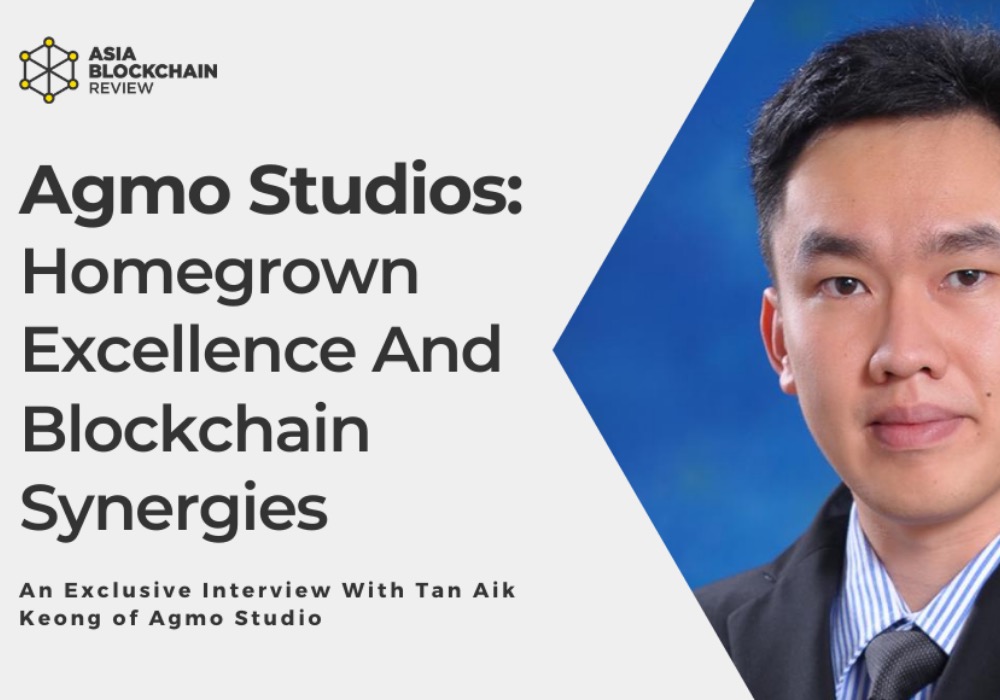
Asia Blockchain Review recently caught up with Tan Aik Keong, the founder and CEO of Agmo Studio Sdn Bhd, an international award-winning software company focused on mobile and blockchain solutions, serving Fortune 500 companies, multinational companies and government agencies.
Agmo Studio has designed and developed many mobile and blockchain solutions, ranging from O2O, e-government, smart home, medical, oil & gas, logistics and more. Its reputable clients include PETRONAS, Toyota, Accenture, Roche, DIGI and MDEC, among others. Today, Agmo Studio has grown its headquarter R&D team to more than 60 professionals.
Could you share some pointers on your company profile and memorable key metrics in your company's journey so far?
Since incorporation, our team has built and published more than 100 Mobile + Blockchain + Web applications, and grown from a team of four to more than 70 software development professionals. The company is doing well from both a technical and a commercial perspective.
In 2020, we launched Vote2U, a Remote Participation and Voting Platform for Public Listed Companies in Malaysia built on Quorum Blockchain Technology. The product generated six-figure revenue within a month of launching.
As a successful business that has been around since 2011, what would be your thoughts on how the government's response has affected local businesses, and do you think more could or should be done?
From the startup ecosystem, we are grateful that the government has launched funding to assist local technology startups, including the Cradle Ignite programme, which provides a conditional grant and value-added assistance of up to RM500,000 for tech-based startups and local SMEs.
The MDEC SME Business Digitalisation Grant has also come in handy, as the need for SMEs to undergo digital transformation has grown significantly amid the Covid-19 outbreak — SMEs can subscribe to software and get up to RM5,000 subsidised by the government.
MOSTI's National Technology and Innovation Sandbox includes a maximum grant of RM250,000 for funding a Single Site Sandbox and a partial grant of up to RM500,000 for a Multiple Site Sandbox, while MDV's Technology Start-up Funding Relief Facility (TSFRF) assists technology startups affected by the Covid-19 pandemic via financial assistance to support their cash flows and ensure business continuity.
How has the pandemic affected your organisation's commercial operations, and what measures has your organisation taken in adapting to this new normal?
We are blessed, as our infrastructure is always ready to commence remote working via collaboration tools such as video conferencing, project management tools, source control and business communication platforms.
Cashless payment is in hot demand as it's contactless and safer in this new normal. Apart from conventional e-wallets, I am looking forward to greater adoption of cryptocurrency-powered micro-transactions, especially with the Bitcoin Lightning Network and Stellar, which can offer faster transaction speeds compared with legacy Bitcoin.
Malaysia has started to embrace blockchain recently, as even GLCs like TM are turning to blockchain to keep up with the times. Why do you think Malaysia has started to open up now, when it could have joined others like Japan or Korea earlier in exploring the technology?
We partnered with TM's subsidiary, Multimedia University, to launch the first-ever blockchain-based election in Malaysia, for their Student Representative Council election in 2019.
I think Malaysian corporates are now more open to the adoption of blockchain after witnessing successful blockchain implementations and their associated benefits at the global level. It's never easy to adopt something new at a large corporate, and blockchain implementation can introduce challenges to policymakers, such as an IT department's difficulty complying with data policies that restrict data storage to Malaysia, since using a public blockchain would involve data storage across nodes worldwide.
From your perspective, how has the journey of digital transformation been so far within your organisation?
We help corporates embrace digital transformation. Our clients include ten Fortune 500 companies and top listed companies in Malaysia, Thailand, Singapore and Hong Kong, whom we help to improve efficiency, increase revenue and automate processes.
Within our own organisation, apart from standard digital office productivity suites and DevOps, we have implemented a couple of customised digital initiatives, such as the Agmoian employee app and a blockchain-powered official pet app for Agmoians called Motomo.
In the Agmoian employee app, we reward and recognise employees who demonstrate our culture pillars — AAA, Kaizen, Do It and Gotong-Royong — with each recognition earning a point that can be redeemed for prizes such as travel vouchers, Steam credit, a day trip with the founder, or an additional day of annual leave.
Motomo Pet uses TRON Blockchain to power a gachapon (lucky draw) element in the app via smart contract, along with an Augmented Reality feature that lets users send a cool greeting card to friends and family.
Are there any lessons that you have learned so far?
Digital transformation is an ongoing journey — it must start as early as possible: set up the objectives, measure the ROI by quantifying and qualifying the outcomes, find the areas of improvement, and improvise and re-iterate the process.
Along the journey, there are always resistances, and the human barrier can be one of the biggest. It's important to get stakeholders excited about the potential benefits and achievements, so that everyone can be aligned and adapt to the changes introduced by digital transformation initiatives, and to keep communication channels open, be transparent, celebrate success and overcome difficulties together.
What will you list as some of the key factors that help a business navigate through trying times?
I like a quote from Robert H. Schuller: "Tough Times Never Last, But Tough People Do!" I think business owners should stay tough, be calm and identify the key issues to sustain the business.
For cash flow issues, look for newly launched government funds and loan facilities amid Covid-19. For operational issues, embrace digital transformation and leverage grants for SMEs, such as the MDEC SME Business Digitalisation Grant and the Smart Automation Grant. For sales issues, leverage digital marketplaces to reach your target customers — for instance, I personally run an F&B business, and we managed to get higher sales during the MCO period than on normal days, due to increased demand from food delivery marketplaces and our self-hosted food ordering website.
Could you share some of the steps your organisation normally takes in blockchain project implementation?
We like to follow the B. Suichies Model when it comes to blockchain project implementation, as sometimes blockchain is overused when it isn't actually needed. The model asks a few questions — such as whether you need a database, whether it requires shared write access, and whether writers are known and trusted — to determine whether you need blockchain at all, and if so, whether to use a public, hybrid or private blockchain.
Once we've determined that we actually need blockchain and the type required, we list out the criteria and perform a Decision Analysis and Resolution (DAR) process — selecting three to five blockchain technologies, assigning weightage to each criterion, assembling subject matter experts to score them, and then selecting the most suitable technology, before following the standard software development life cycle using Agile Scrum methodology.
Do you think government agencies should be more involved in promoting new technology to the public? What else can be done to raise awareness of blockchain in Malaysia?
Due to the fundraising nature of Initial Coin Offerings via smart contract, there have been abuses of blockchain to run crypto-ponzi schemes, which has created a lot of bad impressions and wrong perceptions about the technology.
The Malaysian government is doing a good job, as the Securities Commission was among the first to launch policy to regulate Digital Asset Exchanges and prohibit unauthorised Initial Coin Offerings, and is now regulating Initial Exchange Offerings — a measure that safeguards investors' money from falling into the trap of crypto-ponzi schemes. I think it would be good for the government to start awareness creation from the tertiary education level, as undergraduate students have sufficient knowledge to understand and appreciate the advantages of blockchain, and can become ambassadors to promote the new technology to fellow Malaysians.
This is the reason our blockchain team always collaborates with universities, colleges and polytechnics to conduct free blockchain workshops to up-skill students about the new technology.